

With a video tutorial and in-depth explanations, learn how to properly measure baking ingredients and why measuring is so crucial in baking.

With every recipe I publish, my goal is to help you become a more confident baker. Baking from scratch doesn’t have to be difficult. If you’re set up with the right resources and tools, you can put the FUN back into your kitchen.
Today we’re focusing on something that may seem trivial to you, but it’s the most important step in every recipe you bake. Measuring ingredients properly is imperative. You see, baking is not very forgiving. It’s a science and estimating measurements could spell disaster. While you can easily get away with a handful of this or that when you’re cooking dinner, even the slightest baking miscalculation could turn your soft chocolate chip cookies into rocks. Understanding the correct measuring technique for a particular ingredient will guarantee better baking results. Because the difference between a recipe success and a recipe failure could lie within 1 mis-measured ingredient.
When it comes to baking, it pays off to be a perfectionist. Learn how to properly measure baking ingredients so your next recipe is a success.
How to Properly Measure Baking Ingredients
How to Measure Flour
Flour is the most common mis-measured ingredient. Whether you’re using bread flour, cake flour, all-purpose flour, or any other flours on the market, use the “spoon & level” method. Do not scoop the flour out of the container/bag with your measuring cup because you could end up with 50% more than you need. Rather, using a spoon, scoop the flour into the measuring cup. Do not pack the flour down and do not tap the measuring cup as both cause the flour to settle in the cup. After you’ve spooned the flour into the measuring cup, use the back of a knife to level off the top of the measuring cup.
- Drill this in your head: Spoon & level flour. Do not scoop flour.
- How do I measure sifted flour? If a recipe calls for “1 cup of flour, sifted”—measure the flour, then sift it. If a recipe calls for “1 cup of sifted flour”—sift the flour then measure. It all depends where the word “sifted” is in the ingredient wording. If “sifted” is before the ingredient name, sift before measuring. If “sifted” is after the ingredient name, sift after measuring.
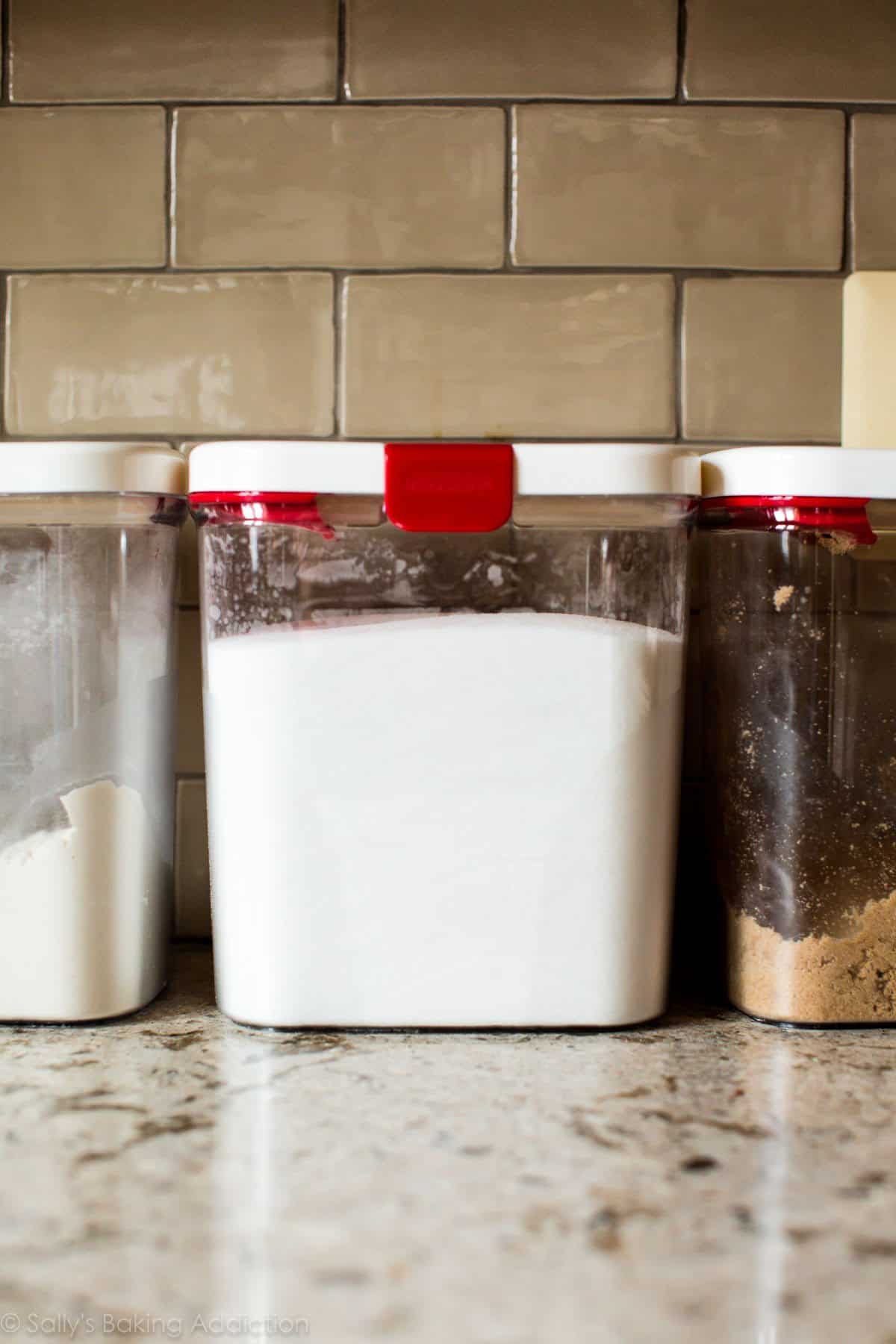
My favorite containers for bulk storing ingredients are these tightly sealed flour keepers. (Affiliate link, I love them!) I own about 10 and recommend them to anyone who asks. I use them for my all-purpose flour, cake flour, bread flour, brown sugar, granulated sugar, and more. They hold 3.8 quarts, which is about one 5 lb bag of flour. I use a label maker to make labels for each—they’re placed on top.
OATS
Make sure you are using the correct type of oats that your recipe calls for. To measure oats, use the same spoon & level method that you use for flour.
Whole oats and quick oats are different and depend on the cut of the oat. I most often use old-fashioned whole rolled oats in recipes like granola, oatmeal bars, and oatmeal cookies. Quick oats are finely chopped whole oats that have a more powdery consistency. When a more powdery, fine oat is ideal in a recipe, I use quick oats. To avoid having two different types of oats on hand in my baking supplies, I make my own quick oats from whole oats. This is very easy: pulse whole oats in a blender or food processor about 5-10 times to break them up to reach the quick oat consistency.
BAKING POWDER & BAKING SODA
Baking powder and baking soda can settle down in their containers over time. Shake it up or give it a stir, then using a measuring spoon, lightly scoop out of the container. Use a knife (or the container if it has a leveler) to level it off.
Always remember the difference in baking powder vs baking soda. Each expire after 6 months, though I find they begin losing strength after 3 months. Write the date on the box so you know when to replace.
DRY YEAST
Standard packets of yeast hold 2 and 1/4 teaspoons, which is 1/4 ounce. If your recipe calls for more or less than 1 standard packet of yeast (or if you are measuring out of a jar or container), measure yeast how you measure baking powder or baking soda.
- Dry yeast can be sold as active-dry or instant. I answer plenty of yeast FAQs, including the difference between yeasts, on my Baking with Yeast page.
- If a recipe calls for dry yeast and you only have cake yeast (aka fresh yeast), use this handy conversion chart.
WHITE GRANULATED SUGAR
Unlike flour, sugar is measured by scooping the measuring cup or spoon into the container/bag until it is overflowing, then leveling it off with the back of a knife. Sugar is heavier than flour, so it’s less likely to pack down into the measuring cup. It’s also more forgiving in recipes than other ingredients because the sweetness of a finished product depends on your tastebuds. However, it is always best to measure the ingredients exactly as the recipe states because sugar crystals are imperative to break down other ingredients. Sugar also aids in proper browning, texture, structure, and stabilization.
BROWN SUGAR
Measure brown sugar like you measure granulated sugar. Unless the recipe states otherwise, brown sugar should be packed into the measuring cup or measuring spoon. Light brown sugar is most common, while dark brown sugar has a slightly stronger molasses flavor. Unless the recipe states otherwise, you can use light brown sugar and dark brown sugar interchangeably.
CONFECTIONERS’ SUGAR (Powdered Sugar/Icing Sugar)
Measure confectioners’ sugar using the same spoon & level method as flour, explained above. Sift confectioners’ sugar if the recipe calls for it. If your confectioners’ sugar is extra lumpy though, it’s best practice to sift it anyway. (No one wants pockets of powdered sugar in their otherwise smooth whipped cream!) As detailed above in the Flour section, 1 cup confectioners’ sugar, sifted means that the sugar is sifted after measuring and 1 cup sifted confectioners’ sugar means that the sugar is sifted before measuring.
COCOA POWDER
Whether you’re using natural or dutched cocoa, measure cocoa powder using the same spoon & level method as flour and confectioners’ sugar. Like confectioners’ sugar, cocoa powder can clump up. If a recipe calls for sifting it, make sure you take the time to do so.
- Further Reading: Dutch-process Vs Natural Cocoa Powder

LIQUID SWEETENERS
Liquid sweeteners include maple syrup, molasses, honey, corn syrup, agave, etc. Measure these thick and sticky liquids in dry measuring cups.
- A handy tip: To easily measure sticky sweeteners, spray the inside of the measuring cup lightly with nonstick spray. This will make it much easier to get the sweetener out of the cup!
LIQUIDS
Liquids used in baking such as milk, water, oil, buttermilk (or this buttermilk substitute), etc should be measured at eye level. Using a liquid measuring cup, pour the liquid into the cup. Then, bend down to make sure the liquid is EXACTLY at level with the measuring requirement of the recipe.
SEMI-LIQUIDS
The semi-liquids I’m referring to here are ingredients like sour cream, yogurt, peanut butter, applesauce, mashed banana, etc. Measure these semi-liquid ingredients in dry measuring cups. They are too thick to be accurately measured in liquid measuring cups. Spoon & level, like you do with sugar or flour, then use a rubber spatula to help release the ingredients into the mixing bowl.
- What about butter? Butter is usually sold in sticks, either 1/2 cup (8 Tablespoons) sticks or 1/4 cup (4 Tablespoons) sticks. This makes measuring very convenient—simply slice off however much you need in a recipe. If your butter isn’t in stick form, use a dry measuring cup to measure it. If a recipe calls for melted butter, measure the butter in its solid state, then melt it.
ADD-INS
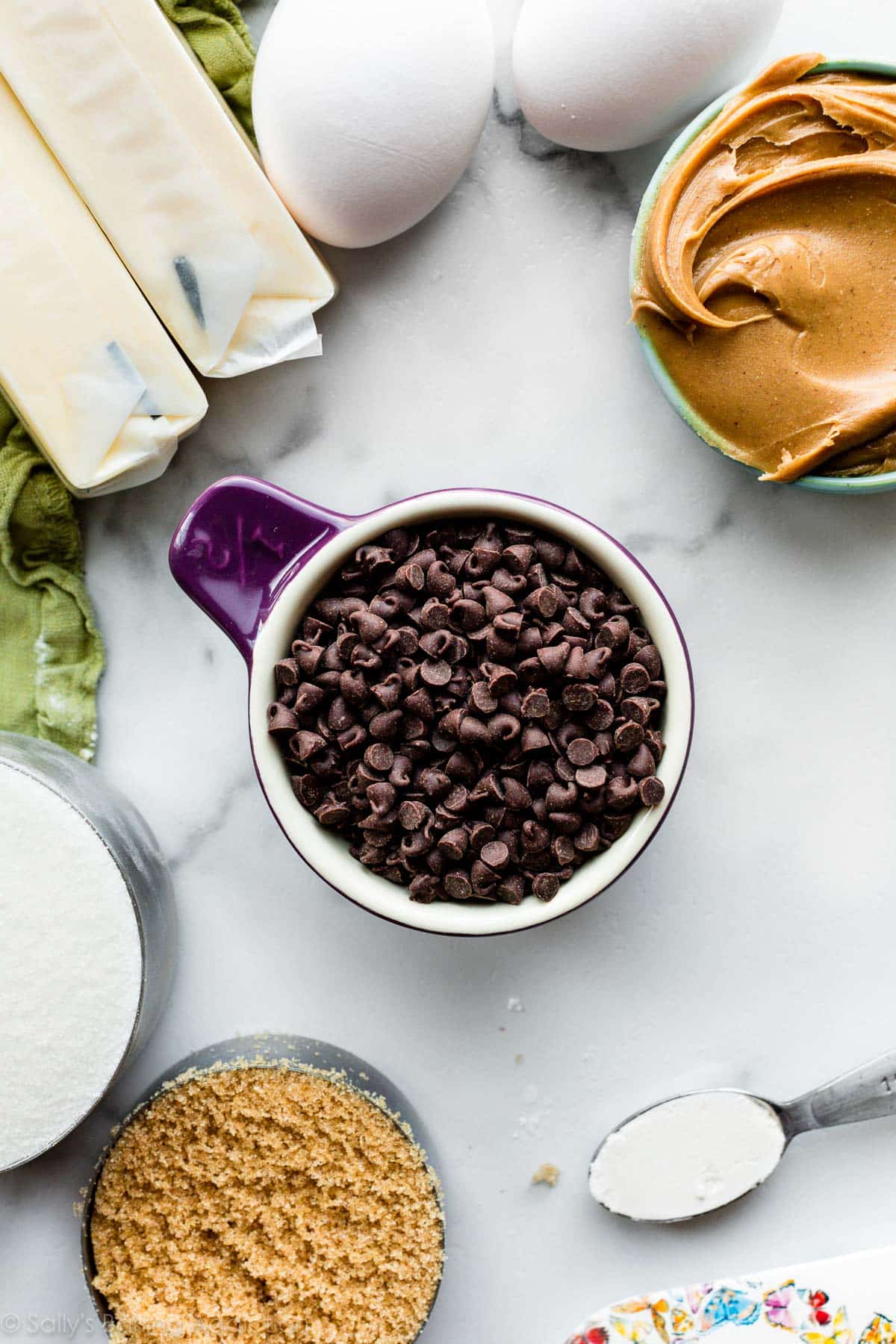
The add-ins I’m referring to here are chocolate chips, chopped fruit, sprinkles, nuts, etc. Simply scoop or pour them into a dry measuring cup. These ingredients aren’t typically used to make up the structure of a baked good, so there’s no need to be as precise.
I find the following measurement equivalents helpful.
Dry Ingredient Equivalents:
- 1 Tablespoon = 3 teaspoons
- 1/8 cup = 2 Tablespoons
- 1/4 cup = 4 Tablespoons
- 1/3 cup = 5-1/3 Tablespoons
- 1/2 cup = 8 Tablespoons
- 2/3 cup = 10 and 2/3 Tablespoons
- 3/4 cup = 12 Tablespoons
- 1 cup = 16 Tablespoons
Liquid Ingredient Equivalents:
- 1 cup = 8 fluid ounces = 1/2 pint
- 2 cups = 16 fluid ounces = 1 pint
- 4 cups = 32 fluid ounces = 2 pints = 1 quart
- 8 cups = 64 fluid ounces = 4 pints
- 4 quarts = 128 fluid ounces = 1 gallon
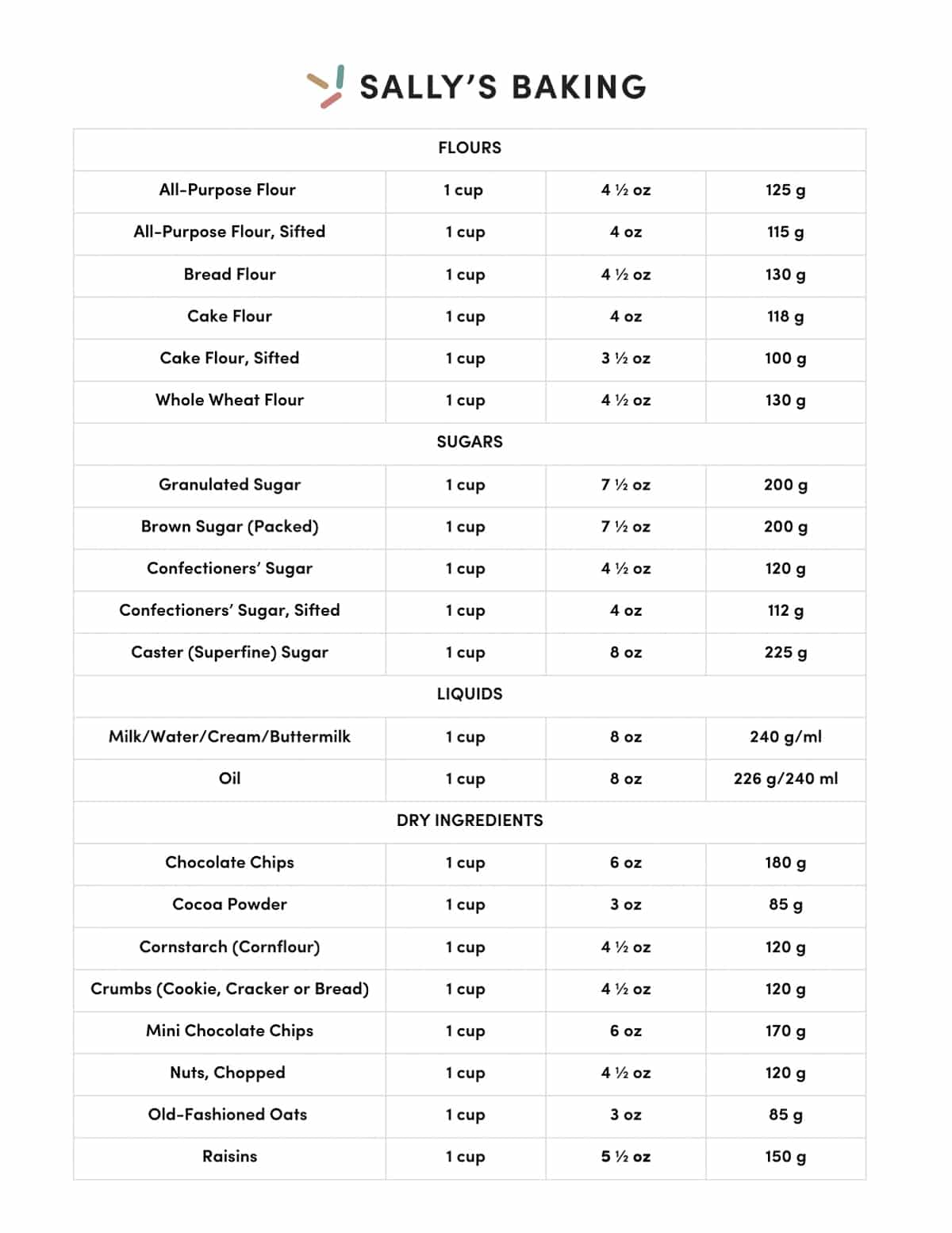
Free Printable PDF for Measuring & Weights
Print out this helpful PDF (3 pages) and have it handy in your kitchen.
**Click this link for the 3-page PDF: Sally’s Baking Recipes Baking Conversions Common Weights
Here is a photo preview of page 1:
Use a Kitchen Scale to Measure
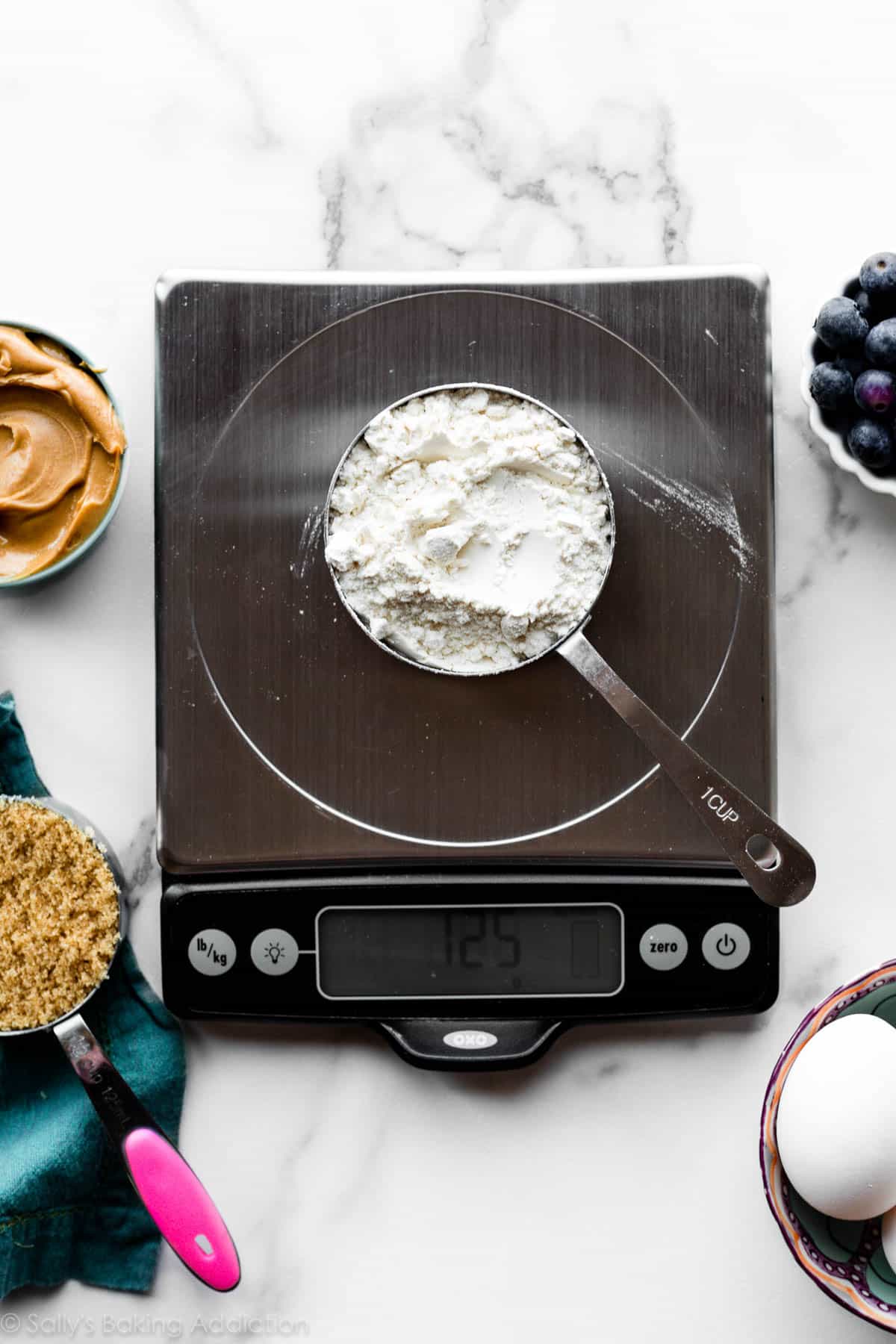
A cup isn’t always a cup, but a gram or ounce is always a gram or ounce. Metric weights, such as a gram or ounce, are most accurate. Cup measurements are standard where I live, so that is why I offer my recipes in both cup and metric measurements.
When I’m developing recipes for my website and books, I weigh the ingredients in my recipe testing. If you want the most precise results, weighing your ingredients will help. No need to spoon & level ingredients if you’re weighing them, but if a recipe instructs you sift the ingredient, it’s still best to do so before or after weighing (depending on which the recipe instructs).
- Here is (affiliate link) the food scale I own.
- Place your measuring cup on the scale, zero it out, then add your ingredient.
Though it’s best to use the weights given if the recipe supplies them, you can refer to the following list if needed. Different products and brands could have different weights, but this is what I usually measure common baking ingredients to be.
Common Baking Ingredients Weights
- 1 cup all-purpose flour = 125 grams (4.4 ounces)
- 1 cup sifted all-purpose flour = 118 grams (4 ounces)
- 1 cup bread flour = 130 grams (4.5 ounces)
- 1 cup cake flour = 118 grams (4 ounces)
- 1 cup sifted cake flour = 105 grams (3.5 ounces)
- 1 cup (packed) brown sugar = 200 grams (7 ounces)
- 1/2 cup butter = 1 stick = 113 grams (4 ounces)
- 1 cup chocolate chips = 180 grams (6.3 ounces)
- 1/2 cup natural unsweetened cocoa powder = 42 grams (1.5 ounces)
- 1 cup confectioners’ sugar = 120 grams (4.2 ounces)
- 1 cup sifted confectioners’ sugar = 115 grams (4 ounces)
- 1/4 cup cornstarch = 28 grams (1 ounce)
- 1 cup granulated sugar = 200 grams (7 ounces)
- 1 Tablespoon honey = 21 grams (.75 ounce)
- 1/2 cup maple syrup = 120 grams (4.2 ounces)
- 1 cup milk = 240 grams (8.4 ounces)
- 1/4 cup molasses = 85 grams (3 ounces)
- 1 cup oats = 85 grams (3 ounces)
- 1/2 cup peanut butter = 125 grams (4.4 ounces)
- 1 cup sour cream or yogurt = 240 grams (8.4 ounces)
Want to Learn More?
My Baking Tips section is growing!
- Cake Pan Sizes & Conversions
- My 10 Best Baking Tips
- Make-Ahead Baking
- How to Prevent a Dry or Dense Cake
- 14 Best Baking Tools That Every Baker Needs
- 10 Best Pie Baking Tools
- Buttermilk Substitute
- How to Decorate Sugar Cookies













Reader Comments and Reviews
You have a typo in your common weights pdf linked in this page. While correctly listed here, 1/4 cup is 4 tablespoons, the common weights pages list it as 1/2 cup.
Hi Carol, thank you so much for catching that! We will get it fixed.
What about butter? When recipe says 1/2 cup do you use dry and the pack.method? If it says melted, is that measure before or after melting or is it the same no matter which way? Thanks for all the tips already. Love your recipes.
Hi Cassandra, melted butter and solid butter have the same volume, it’s usually easier to measure before melting if it is in sticks.
I tried your pizza and pizza sauce recipes. Family got so happy with soft, none chewe
crust.
My son inlaw asked: Mom where did you get dough from!!!
Thank you
Thank you for your generosity. A lot of time and effort went into compiling this and although I’ve been baking for a very long time I know there are always things to learn. I do have a dilemma… people who write in to you generous cooks saying I used this instead of that and I cut down (or up) on some ingredient and then ask “Why did it fail”? You have lots of patience mixed with your generosity, so thank you once again.
Weighing ingredients is so much easier! And it’s the most accurate if you have a decent scale. I am baffled by the fact that Canada, my home country, and the USA has not fully converted to this method. Almost every single “dry” ingredient that is packaged and sold in a box, bag, can, or bottle displays the weight. Why? Because it’s the most accurate! And it’s the easiest way for factories to measure ingredients!
I found you, Sally, because I searched for bakers who used weights. You were suggested by many on Reddit.
I’m just about to try your banana bread recipe for the first time. I’m excited to taste it but equally so to mix it and bake it. I find those parts super fun!
Thank you for your wonderful recipes and sharing your gifts with the world!
Love all of this
I have been the lucky recipient of fresh eggs from a friend lately. What is the recommended weight for a large egg in your recipes?
Thank you!
Hi Katie, Egg weights can vary but usually large eggs in the shell are about 57g, and 50g out of the shell. Hope this helps!
Thank you for making a great video – I showed it to beginner culinary students. (I frequently use your recipes both in class and for our school baking club – I love the step by step pictures and videos!) There is a discrepancy in the video, though, that I had to point out to students. You say to pack brown sugar, but then demonstrate to measure it the same way as granulated sugar. 🙂
Hi Valerie! Thanks for pointing this out. I consider brown sugar to be packed in the measuring cup if you are scooping it out of the bag/container. Of course this depends, but in the video, I remember and can see that it was pretty packed in the cup!
Why do you sift the flour? Is it really necessary if I fluff my flour before measuring
Hi Debra, if a recipe calls for sifting flour, it’s to break up any lumps and aerate the flour, which will result in a lighter, fluffier baked good.